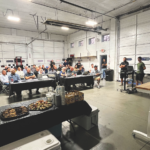
 9.28.26 – The Alliance of Automotive Service Providers of New Jersey (AASP/NJ) resumed its educational programming last week with “Vehicle Safety Inspections: A Shop Perspective” at Dashlight Solutions (Wall Township, NJ) to help guide the collision repair community on the critical importance of safety inspections in today’s repair environment.
Sponsored by Carmic.ai and led by Mike Whitney and Rob Kirk of Dashlight Solutions, along with Anthony McNee of Ultimate Collision (Edison), the seminar set out to educate repair professionals about safety inspection procedures, documentation requirements and related key areas of concerns. Attendees also received a certificate upon course completion to be used toward the training requirement of 2026 NJ-MVC Auto Body License renewal.
The presenters stressed the importance of the need for the industry to embrace OEM required safety inspections.
Kirk equated it to pre- and post-scanning, a required procedure not widely accepted at one point in time. “Years ago, not everyone was pre- and post-scanning vehicles. Now, it’s the norm. It is what we do, as it’s part of the process and it’s agreed upon no matter who you talk to. We want to see safety inspections become part of the process.”
Showing various examples of damaged parts including partially-deployed airbags and bent or collapsed steering columns, Whitney and Kirk spoke of the dangerous consequences of not uncovering these safety threats if one were to skip the inspection process. Uncovering a collapsed steering column is more common than one would expect according to Kirk, who admitted to seeing more than a handful of them. “We’ve seen these more from rear collisions rather than frontal,” Whitney pointed out.
If something appears to be deformed, it most likely is. Kirk showed the audience a new airbag with a small bulge on its cover – an indication of deformity. “It’s not up to us to define a deformity,” he explained. “If it’s not straight the way it’s supposed to be, it’s deformed.”
“If you find yourself questioning how something is supposed to look, it’s probably not right,” Whitney added.
McNee provided insight into estimating for safety inspections, recommending keeping the procedure down to one line on the estimate so it’s not seen as a multi-step process. He’s also found success in creating a basic checklist. “I make a checklist for myself so I can visually go down the list. It makes it pretty simple. Jumping around between the different things you need to inspect could lead one to miss something.”
Kirk and Whitney also showed the audience examples of measuring tools and gauges used in the inspection process, explaining that ultimately, research is the key behind safety inspections.
“Every single procedure is different,” Kirk emphasized. “Don’t assume the last group of inspections you did will be the same as the next. Always look up the procedures. Don’t print them out and expect to be able to use them another time.”
Circling back to his point about pre- and post-scanning, Kirk insisted, “Safety inspections have to be done. We know it needs to be done. The things you’ll find will open your eyes and you’ll ask yourself why you didn’t do this earlier.”
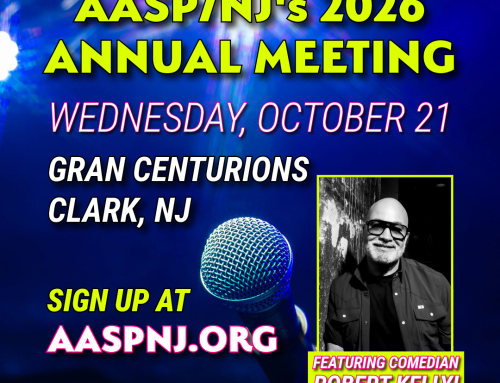
AASP/NJ thanks Dashlight Solutions and Ultimate Collision for their help in facilitating this event, and Carmic.ai for their generosity as meeting sponsor. Coming up next on AASP/NJ’s schedule of events is its 2026 annual meeting, happening Wednesday, October 21 at Gran Centurions in Clark, NJ. To register, visit aaspnj.org.